Count confirmed child diners and adult diners separately. For a two-hour meal party serving pizza, fruit, and dessert, order two slices per diner. Divide the slice total by the restaurant’s actual slices per pizza and round up.
Planning the whole party? The $15 fillable PDF puts the complete plan on your device. The $25 private Builder applies it to your guest count, venue, food route, budget, timing, and constraints.
Get the $15 Birthday PDF ↗Use the $25 Birthday Builder ↗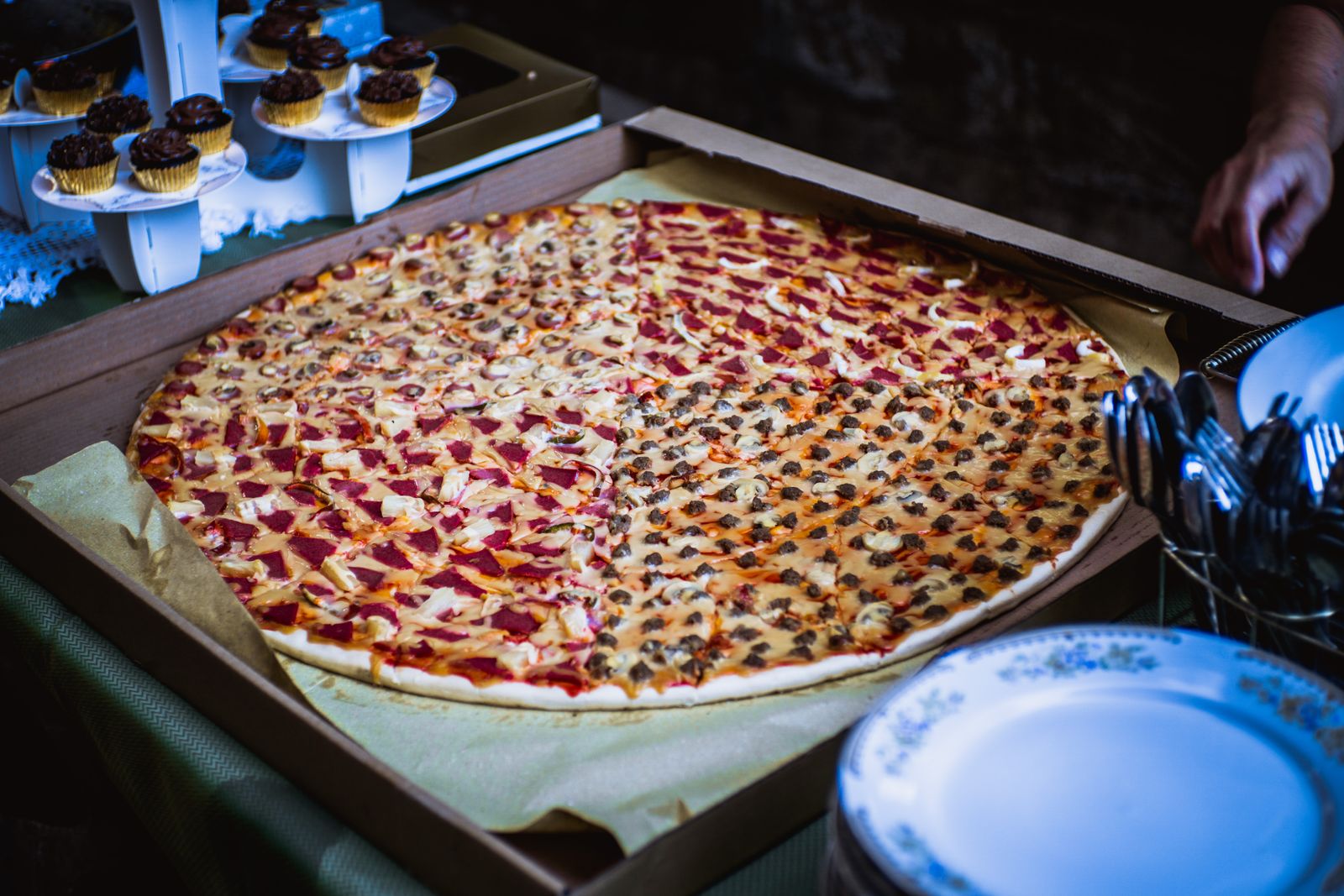
JUMP TO THE PART YOU NEEDOpen this guide’s sections
Count every confirmed diner
Write three totals before choosing food. Confirmed child diners are invited children who accepted, the birthday child, and confirmed siblings. Confirmed adult diners are adults staying plus household members or helpers who will eat. Total confirmed diners are both groups added together.
Use this Short Plan deadline: close the count no later than 24 hours before you must buy or order the food. Send one direct follow-up to each nonresponder and state the closing time. No reply counts as no after that deadline.
Add a late yes only when the vendor accepts the change, the venue still has space, and you recalculate every affected quantity. Once the three totals are fixed, choose the meal or snack route.
USE THISI’m finalizing the food count at 6 tonight. Can you tell me whether Sam is coming? If I don’t hear back, I’ll plan for no.
Decide between a meal and snacks before calculating
Use the meal route when the invitation promises lunch or dinner or the party overlaps the time your guests ordinarily eat that meal. Serve one substantial main, fruit, dessert, water, and one optional packaged drink.
Use the snack route outside meal time. Serve one fruit portion, one easy snack portion, dessert, and water. Write “snacks and cake” on the invitation so nobody arrives expecting lunch.
A venue package controls when it requires specific food or prohibits outside food. Read the written policy before buying anything.
Use one house formula for each food
These quantities are Short Plan planning defaults for a two-hour ages 3–6 party, not universal serving standards. Use the exact restaurant, caterer, bakery, recipe, or package yield to convert each formula into purchasable pizzas, trays, boxes, or packages.
Start with total confirmed diners for each formula. Subtract a child only from an affected main or dessert when the parent confirms the child will bring a separate item and will not eat the host-provided version.
- Meal-route pizza: total confirmed diners × 2 slices. Divide by the restaurant’s actual slices per pizza and round up. This creates one shared pizza pool; do not add separate child and adult maximums or another percentage buffer.
- Full sandwiches: total confirmed diners × 1 sandwich.
- Mini sandwiches or sliders: total confirmed diners × 2 pieces when fruit and dessert are also served. For a tray sold by main-meal yield, divide total confirmed diners by the stated diners per tray and round up. Do not use both calculations.
- Nuggets or tenders: divide total confirmed diners by the seller’s stated main-dish yield and round up. If the seller provides only a piece count and cannot give a main-dish yield, get a written answer or choose the pizza or sandwich route.
- Fruit: one whole piece or one stated serving per total confirmed diner. For a platter, divide total confirmed diners by the stated servings per platter and round up.
- Easy snack: total confirmed diners × 1 serving. An individual packet counts as one serving. For a larger package, divide the serving total by the stated servings per package and round up.
- Dessert: total confirmed diners × 1 serving. Round up to the next bakery or package size.
- Kid drinks: when offered, confirmed child diners × 1 individual drink. Otherwise water completes the child drink plan.
- Adult drinks: confirmed adult diners × 1 only when you are offering a non-water adult drink. Otherwise water completes the adult drink plan.
- Water: one cup per total confirmed diner beside a refillable pitcher or dispenser. If bottled water is the only source, buy one bottle per diner and provide a refill source.
Eight invitations become five pizzas for this meal route
Eight confirmed invited children plus the birthday child and two siblings produce 11 confirmed child diners. Seven parents plus two household members or helpers produce nine confirmed adult diners. The total confirmed diner count is 20.
The meal-route pizza calculation is 20 × 2 = 40 slices. If the restaurant cuts each pizza into eight slices, 40 ÷ 8 = 5. Buy five pizzas. If it cuts each pizza into ten slices, 40 ÷ 10 = 4. Buy four. The restaurant’s cut changes the number of pizzas, not the 40-slice target.
The same meal route needs 20 fruit servings and 20 dessert servings. If you offer packaged drinks, buy 11 kid drinks and nine adult drinks. Put out 20 water cups with a refill source. The full-sandwich route needs 20 sandwiches; the loose-slider route needs 40 sliders.
Let the parent define allergy-safe
Ask about food allergies on the invitation. When a parent reports one, ask which exact foods or brands work, how cross-contact changes the answer, and whether the parent wants to send a sealed meal or treat.
Keep ingredient labels and packages until the party ends. Most U.S. packaged foods must identify the nine major allergens, but they do not cover most restaurant food, homemade food, or every product category. Advisory statements such as “may contain” are voluntary. Ask directly about ingredients and handling.
Share the available labels and handling details with the parent. Let the parent decide whether the proposed food works for the child. Promise an allergen-free kitchen only when the provider can support that claim.
Keep the child in the seating and water count. Remove the child from a main-food or dessert quantity only when the parent confirms the child will bring a separate item and will not eat the host-provided version. Recalculate only the affected food.
Prepare food for the youngest eater
Prepare every food for the youngest child who will eat it. Seat children upright, supervise them throughout eating, and match food shape, size, and texture to the child’s development.
Cut grapes and small tomatoes into smaller pieces. Do not serve young children hot dogs, meat sticks, sausages, whole or chopped nuts or seeds, popcorn, hard or round candy, marshmallows, or large chunks. If a food cannot be prepared to a safe size, shape, and texture for the youngest eater, do not serve it to that child.
Assign one adult to remain at the food table while young children eat. Give that job to a named person before guests arrive.
Start the perishable-food clock when temperature control ends
Keep cold food at 40°F or below and hot food at 140°F or above. Once perishable food leaves effective temperature control, refrigerate or discard it within two hours—or within one hour when it is exposed to temperatures above 90°F. (FoodSafety.gov: Four Steps to Food Safety)
Travel and setup time count only while the food is outside a refrigerator, properly packed cooler, or effective hot-holding equipment. Record the time temperature control ended and name the adult who will refrigerate, re-chill, or discard the food on schedule.
Stop after one main, one fruit, one dessert, and drinks
One main gives up extra variety, but it also removes another purchase, serving dish, storage problem, temperature check, and cleanup job. Skip the separate adult buffet, second substantial main, dessert table beside the cake, personalized water bottles, and themed label for every snack.
The plan is good enough when the chosen main, fruit, dessert, water, and each packaged drink you chose to offer have a quantity tied to the confirmed diner totals. Stop there.
Finish when every food has a number
The order is finished when the child count and adult count are written, every menu item has a quantity, the venue accepts the food, reported allergies have a parent-approved route, and one named adult owns food safety during service.