Count everyone who will eat. Multiply that number by 1.08 and round up. Then choose one menu: brunch or lunch, a grazing menu, or cake and punch. Use only the quantities listed for that menu.
Start with one number
First, count every person who will eat. Include:
- confirmed guests;
- the bride and partner, if attending;
- hosts and helpers who will eat;
- children;
- photographers, vendors, or other workers you have agreed to feed.
Next, use a calculator to multiply that number by 1.08. Round the answer up to the next whole number.
Example: If 24 people will eat, calculate 24 × 1.08 = 25.92. Round up to 26.
We will call 26 your Buying Count. The Buying Count is the number you will use in every food calculation below. It creates a small amount of extra food for ordinary differences in portions and appetites.
Choose one menu
| If the shower… | Choose… | Plan for each person in the Buying Count |
|---|---|---|
| overlaps a normal breakfast or lunch time | Brunch or lunch | 1 entrée serving, 1 serving of each of 2 sides, and 1 dessert serving |
| falls between meals and the invitation promises substantial appetizers | Grazing menu | 12 appetizer-size savory pieces and 1 dessert serving |
| is held in midafternoon and the invitation says light refreshments will be served | Cake and punch | 6 small savory bites and 1 dessert serving |
Choose one row. Do not combine the quantities from multiple rows. These formulas cover two hours of food service.

JUMP TO THE PART YOU NEEDOpen this guide’s sections
01 — Count Everyone Who Will Eat
Use the final RSVP list, then add every host, helper, child, and worker who will be fed. Do not use the number of invitations sent. Use the number of actual people eating.
At the RSVP deadline, remove unanswered invitations from the food count. A late yes can be added only when:
- the venue still has room;
- every affected food order can still be changed;
- the guest’s dietary needs can be handled;
- the person paying approves the added cost.
A late guest can be added only if all four conditions are met. If even one condition cannot be met, leave the guest off the final food count and say:
“I’m sorry, but the final guest count and food order are already closed, so we’re unable to add another guest.”
02 — Add the Food Buffer Once
Multiply the number of people eating by 1.08, then round up.
People eating × 1.08 = Buying Count
The Buying Count is not a new guest count. It is the number you use when calculating how much food to buy.
Add this buffer once. Do not add another 8% to every tray, package, or individual dish. Package rounding will often create a little additional food on its own.
SELF-SERVICE CALCULATOR
Enter the people eating.
Get the Buying Count.
This calculator covers a two-hour self-service shower and adds the 8% buffer once. If a caterer supplies written yields or a guaranteed-count rule, use the caterer’s numbers.
03 — Match the Menu to the Start Time
Guests expect a meal when a shower overlaps a normal mealtime. If people arrive at 11:30 a.m., cake and punch will feel incomplete even if the invitation calls the event casual.
A grazing menu works when the shower falls between meals and you have promised substantial appetizers. Guests should be able to make a satisfying plate from the food provided.
Cake and punch works for a midafternoon shower when the invitation makes the lighter menu clear. The invitation should say “Cake and light refreshments will be served” so guests know whether to eat beforehand.
Choose the menu before shopping. Use the shower’s start time and invitation wording to set the amount of food guests should expect.
04 — Turn Servings Into Trays and Packages
The Buying Count tells you how many servings a food category must provide. It does not tell you to buy that amount of every individual dish.
Brunch or lunch example
If the Buying Count is 26, you need:
- 26 entrée servings total;
- 26 servings of the first side;
- 26 servings of the second side;
- 26 dessert servings.
You can split the entrée total. Twenty quiche servings plus six vegetarian entrée servings equals 26. You do not need 26 servings of both.
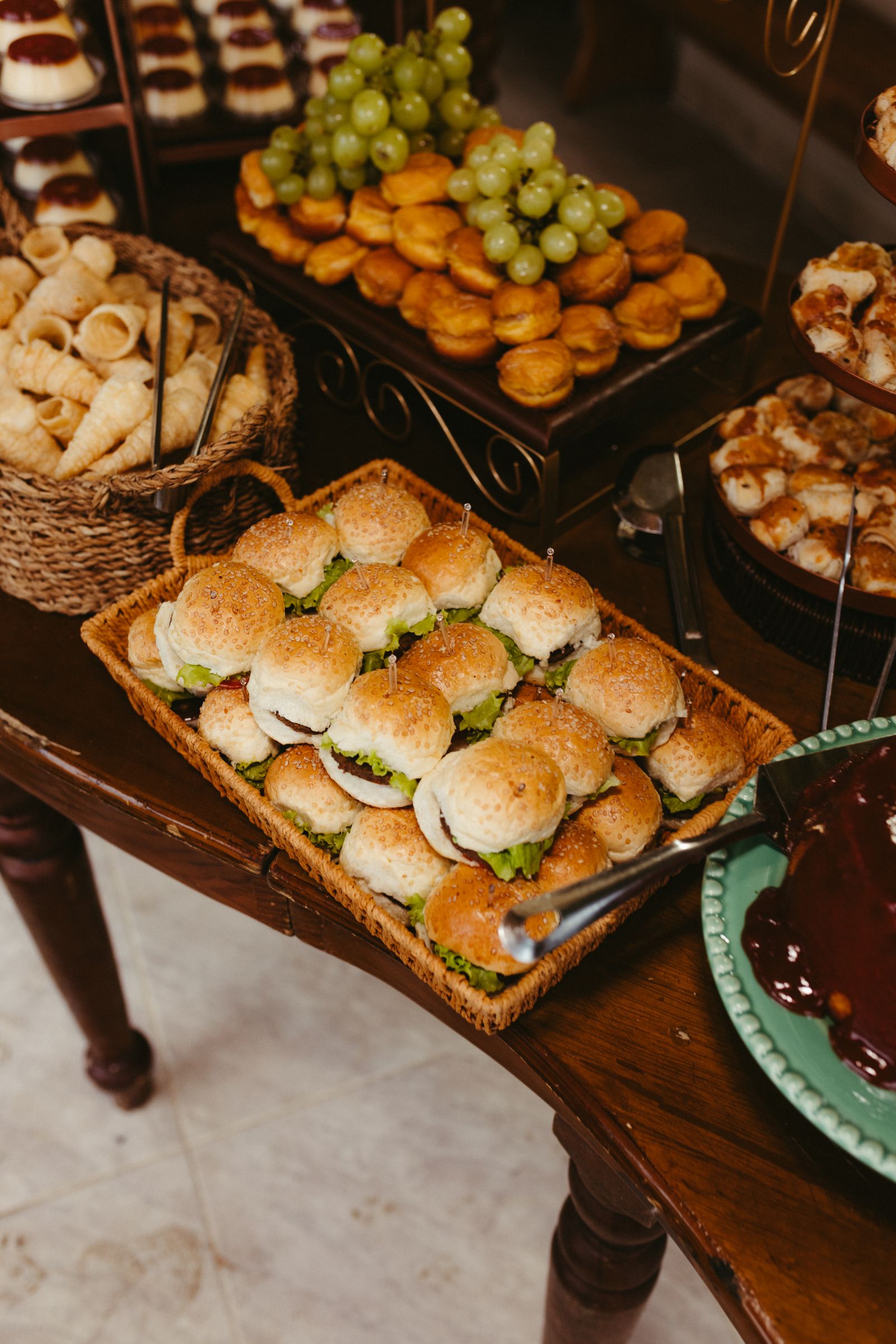
Grazing-menu example
If the Buying Count is 26:
26 × 12 savory pieces = 312 savory pieces total
The 312 pieces are divided across every savory appetizer on the menu. Do not buy 312 pieces of each appetizer.
Cake-and-punch example
If the Buying Count is 26:
26 × 6 light bites = 156 light bites total
You also need 26 dessert servings.
Convert servings into purchasable amounts
Read the package label or ask the vendor how many servings the item provides.
If a fruit tray serves 12 people and you need 26 fruit servings:
26 ÷ 12 = 2.17 trays
You cannot buy 0.17 of a tray, so round up and buy three trays.
If a label does not state the yield, count the pieces or ask the vendor before ordering. “One large tray” is not a usable quantity until you know how many servings it contains.
05 — Plan Dietary Food With the Guest
Ask this with the RSVP:
What ingredients or cross-contact risks do we need to avoid, and would a sealed item or a restaurant meal feel safer?
The nine major U.S. food allergens are milk, eggs, fish, crustacean shellfish, tree nuts, peanuts, wheat, soy, and sesame. These nine are a label-checking starting point, not a complete list of every allergy or food restriction.
For any guest who reports an allergy or cross-contact concern:
- confirm the exact food with that guest;
- read the complete ingredient label every time you buy it;
- keep the original package available at the shower;
- store and serve the food separately when cross-contact is a concern;
- never promise that a food is safe when the vendor cannot verify it.
A sealed package is not automatically safe. Use a sealed or restaurant-prepared alternative only when the affected guest approves that exact item.
06 — Give Every Food Item an Owner and a Time
A shopping list says two sandwich platters. A service plan says 48 sandwich halves, picked up from Green Street Deli at 10:30 a.m., refrigerated until 11:45, and placed on the table by Nina.
Write down five things for every food and drink:
- Quantity: the number of trays, packages, bottles, gallons, or pieces;
- Source: the store, vendor, or person making it;
- Time: when it will be purchased, picked up, prepared, or delivered;
- Storage: where and how it will be held until serving;
- Owner: the specific person responsible for it.
If one of those fields is blank, the item is not fully planned.
07 — Calculate Drinks Separately
For a two-hour shower, plan two nonalcoholic drink servings per person, plus drinking water. Divide those servings among the drinks you are actually offering.
If the Buying Count is 26:
26 × 2 = 52 nonalcoholic drink servings total
That means 52 servings divided among punch, soda, coffee, tea, or other drinks. It does not mean 52 servings of every drink.
Use these conversions:
- Punch: 1 gallon provides 32 four-ounce servings.
- Soda: 1 two-liter bottle provides 8 full eight-ounce servings.
- Coffee: Use the brewer’s finished capacity in ounces and divide by the amount you plan to pour into each cup. A brewer’s labeled “cup” may be smaller than the cup guests will use.
- Water: Keep it available throughout the shower, even when other drinks are served.
If alcohol will be served
Do not assume every adult will drink. Count only the legal-age guests you expect to drink, then decide how many hours alcohol will be available.
Use this purchasing limit:
Expected drinkers × hours of alcohol service × 1 standard drink = maximum number of standard drinks to buy
Example: If 18 guests may drink and alcohol will be served for two hours:
18 × 2 × 1 = 36 standard drinks maximum
Convert that total into the beverages you are serving:
- Beer: One 12-ounce beer at 5% alcohol equals approximately one standard drink. A 12-pack provides 12 standard drinks.
- Wine: One 750-milliliter bottle of wine at 12% alcohol provides approximately five standard drinks.
- Spirits: One 750-milliliter bottle at 40% alcohol provides approximately 16 measured standard drinks.
- Higher-alcohol products: Check the alcohol percentage. A strong beer, large wine pour, or heavily mixed cocktail may contain more than one standard drink.
Do not buy the maximum amount of every beverage. Divide the total among the drinks you are offering.
Example: A 36-drink maximum could be:
- 24 beers; and
- 12 wine servings, which requires three 750-milliliter bottles.
Keep serving simple:
- appoint one sober person to control the alcohol;
- measure wine and spirits rather than free-pouring;
- avoid an unmonitored self-serve bar;
- serve food, water, and appealing nonalcoholic drinks throughout the shower;
- stop serving anyone who appears impaired;
- decide before the shower how a guest who should not drive will get home;
- follow the venue’s alcohol rules and any local requirements.
A one-standard-drink-per-hour cap controls purchasing and pouring. It does not guarantee that a guest is safe to drive.
08 — Keep Perishable Food at a Safe Temperature
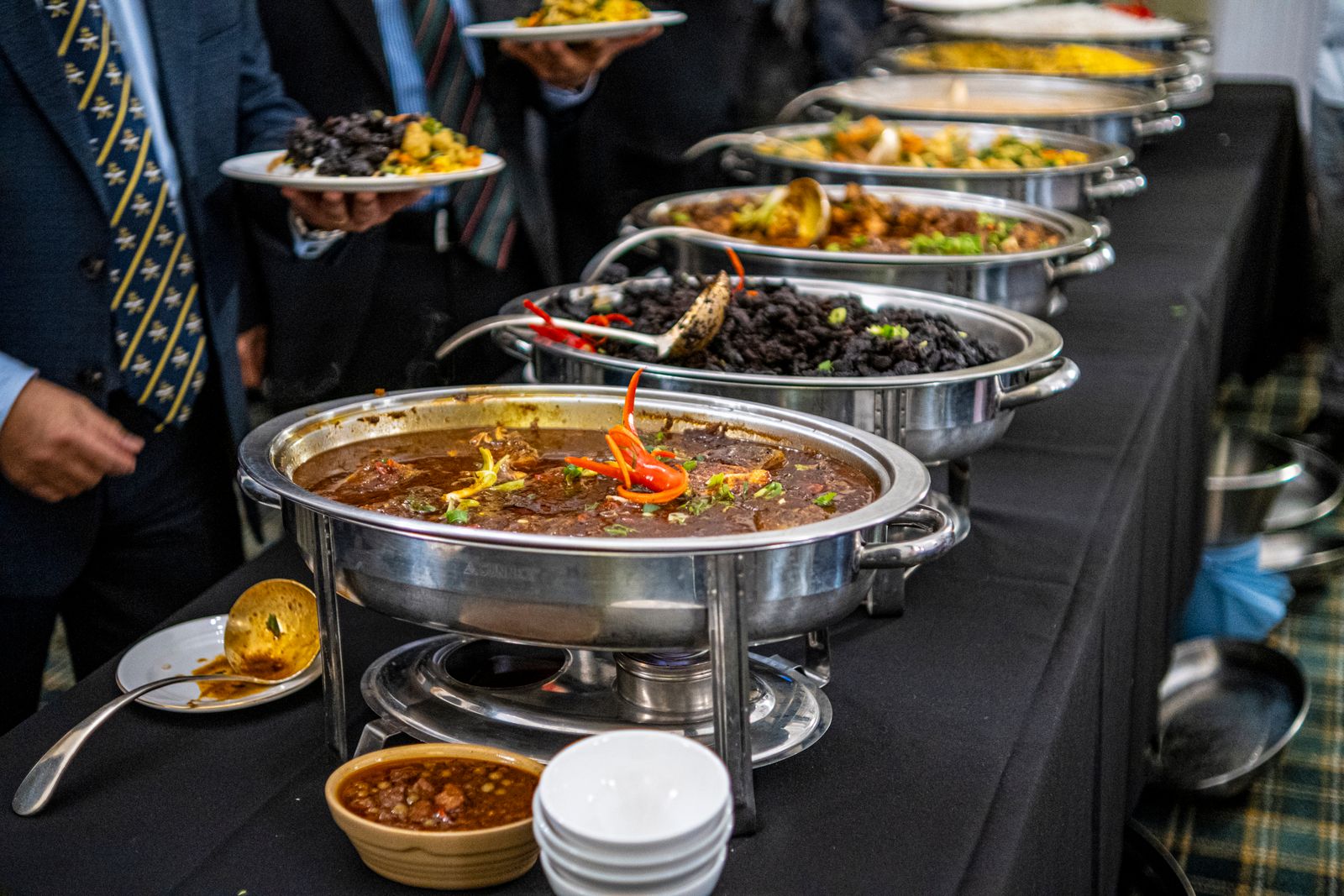
Keep cold perishable food at 40°F or below. Keep hot food at 140°F or above.
Once perishable food is no longer being held at a safe temperature, serve or discard it within:
- two hours under ordinary conditions;
- one hour when the air temperature is above 90°F.
Use small serving platters. Keep the backup food refrigerated or properly heated, then replace a platter when needed. Do not add fresh food to a dish that has already been sitting on the table.
Use a food thermometer instead of guessing. Temperatures outrank photographs. Photos can wait.
09 — Stop When Every Category Is Covered
Your food plan is complete when:
- the final number of people eating is closed;
- the Buying Count is written down;
- one menu format is selected;
- every required food category covers the Buying Count;
- servings have been converted into actual trays and packages;
- every dietary alternative is confirmed with the guest;
- drinks have been calculated;
- every item has a source, time, storage plan, and owner;
- the food can be held and served at safe temperatures.
Order the food, save the confirmations, and stop adding dishes.
FOOD IS PLANNED
Count the people eating, add the 8% buffer once, choose one menu, and buy the quantities in that row. Then assign every item to a person, time, and storage plan.
IF YOU WANT HELP WITH THE REST OF THE SHOWER
Food depends on the final guest count, budget, dietary needs, pickup times, refrigerator space, helpers, and party schedule. There are two ways to connect those decisions:
| You need | Use this | Status |
|---|---|---|
| The whole shower in one fixed sequence | Bridal Shower Short Plan | $24 at launch · launch list open |
| A plan calculated from your own answers | Bridal Shower Builder | $39 · available now |
The Builder turns your date, guest count, venue, budget, food route, helpers, and constraints into deadlines, quantities, shopping, assignments, a setup plan, and a party-day run sheet.
Build My Bridal Shower →